Hypocritic Toxic Tuna 2.0 - A Comprehensive Analysis of Methylmercury in Global Seafood Market.
Wed Apr 29 2026856
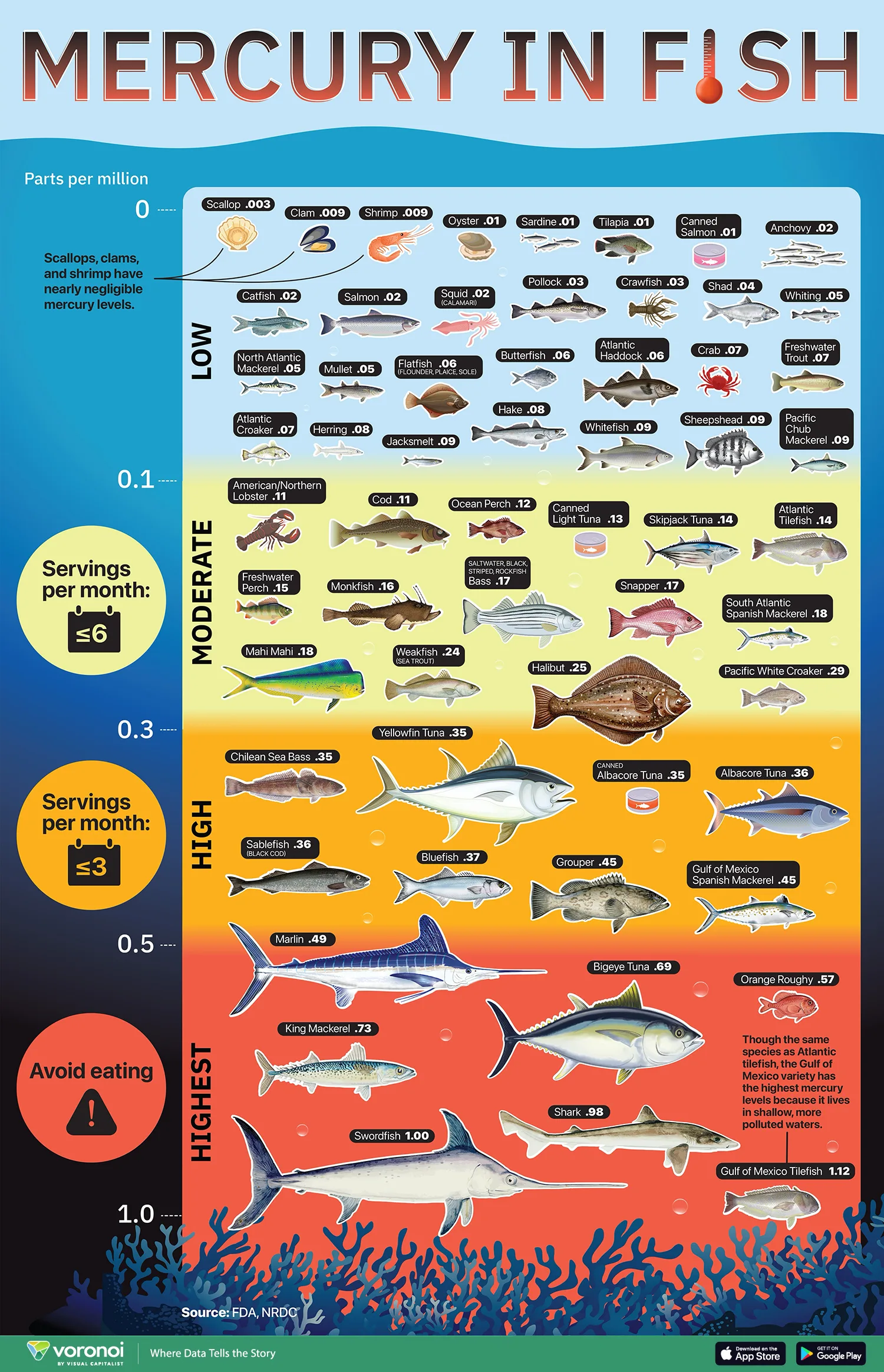
Growing up, we constantly use to hear how good seafood are for our health and benefits of seafood on our heart, but is it good for our over all body? The very same marine species recommended for their health benefits simultaneously deliver one of the environment’s most efficient and destructive neurotoxins: Methylmercury.
Mercury enters the global environment through a combination of natural events and massive human emissions (coal combustion, industrial effluents). Once in the ocean, inorganic mercury is biologically transformed by microorganisms in sub-surface, low-oxygen waters into methylmercury (MeHg). This organic form is highly bioavailable and aggressively biomagnifies up the food chain. Tuna's deep mesopelagic foraging (17-55% diet) accesses MeHg-rich prey, slowing growth and concentrating toxin via "growth dilution failure." Hotspots like Mediterranean/North Pacific show highest rates; stable levels 1971-2022 reflect "marine inertia" from legacy pollution, persisting decades despite emission cuts (Mdieu et al., 2024).Accumulation rates are unequivocally highest in the Mediterranean Sea, followed by the North Pacific Ocean, the Indian Ocean, and finally the North Atlantic Ocean. This hierarchy directly and proportionally reflects the bioavailability of MeHg at the very base of regional food webs.
When you eat apex predators like tuna or swordfish, this neurotoxin is inextricably bound to the muscle tissue—you cannot cook it out or cut it away. This has forced international regulatory bodies into an increasingly untenable position: formulating safety limits that protect vulnerable populations (fetuses, infants, and frequent consumers) without affecting the commercial viability of the multi-billion-dollar global fishing industry.
The European Union (EU) Framework
Recently updated through Commission Regulation (EU) 2022/617, the EU aims to lower dietary exposure to mercury, guided by the European Food Safety Authority (EFSA). EFSA established a Tolerable Weekly Intake (TWI) for methylmercury at 1.3 micrograms per kilogram of body weight per week . EFSA modeling determined that high-frequency fish consumers, particularly pregnant women, could dangerously exceed this TWI by up to six-fold. To address this, the EU created a tiered system:
The Strict Limit (0.30 mg/kg): Applied to frequently consumed, lower-trophic species like anchovy, Atlantic cod, herring, salmon, and mackerel. Occurrence data showed that industry could meet this strict limit without disrupting the supply.
The Relaxed Limit (1.0 mg/kg): Reserved for apex predators that serve as highly lucrative export commodities, including commercial tuna, swordfish, marlin, and various sharks.
US FDA & Health Canada
The United States utilizes a strict reference dose (RfD) developed by the EPA, defined as daily exposure over a lifetime without appreciable risk of harm. For methylmercury, this is set at the Reference Dose (RfD) at 0.1 micrograms per kilogram of body weight per day.
However, the US FDA enforces a high regulatory "action level" of 1.0 parts per million (ppm, equivalent to mg/kg) for all fish in commercial sale. Instead of banning fish that test near this limit, the FDA relies on categorized consumption advisories, urging pregnant women to entirely avoid high-mercury species (shark, swordfish, king mackerel).Health Canada employs a dual-standard risk management strategy.
Baseline Standard: 0.5 ppm total mercury for most retail fish."Discrete List"
Exemption: Shark, swordfish, fresh/frozen tuna, escolar, marlin, and orange roughy are allowed a relaxed 1.0 ppm standard.
Japan’s Unique Historical Burden and the Tuna Exemption
Japan's approach is deeply scarred by the tragedy of Minamata disease in the 1950s and 60s, a catastrophic neurological syndrome caused by massive industrial methylmercury poisoning.
In 1973, responding to public panic, the Japanese government issued strict provisional regulatory values: a maximum of 0.4 ppm for total mercury and 0.3 ppm for methylmercury in all marketed seafood.
However, this sweeping regulation contained a monumental, market-defining caveat that persists today. The regulation explicitly stated that the strict 0.3 ppm limit absolutely did not apply to tuna species (Maguro), swordfish (Kajiki), or skipjack (Katsuo).
There was no toxicological justification provided for this exemption; it was a pragmatic economic compromise. Because these pelagic predators naturally biomagnify mercury well above 0.3 ppm, enforcing the health-based limit would have instantly decimated the culturally foundational Japanese tuna market.
How the Industry Weaponizes ‘ALARA’
They use a principle called ALARA: "As Low As Reasonably Achievable."
Traditionally, ALARA is a safeguard used to drive contaminant exposure down to the minimum level technically feasible. However, in commercial seafood regulation, the industry has successfully inverted this concept, transforming it into an economic shield designed to protect market viability.
During deliberations by the Codex Alimentarius electronic Working Group (eWG)—the international body for harmonizing food standards—organizations representing massive European fish processors argued fiercely to defend the 1.0 mg/kg limit for tuna.
Their argument centers entirely on the statistical distribution of mercury in commercial catches, not human health. Because methylmercury biomagnifies continuously, total mercury is highly correlated with the size and age of the fish.
Industry analyzes occurrence data to find the 95th percentile (P95 statistic)—the concentration below which 95% of the total commercial catch falls. For major commercial tuna species, the P95 is approximately 0.96 mg/kg.
Industry argued that because a 1.0 mg/kg limit seamlessly accommodates 95% of the "normal variation" in the oceanic food supply, it aligns with ALARA. They asserted that setting the limit any lower (such as forcing tuna to meet the 0.3 mg/kg standard applied to cod) would cause "undue disruptions of trade."
By this logic, 1.0 mg/kg is the lowest level "reasonably achievable" if the goal is to keep the commercial tuna industry fully operational. This reveals a stark reality: the regulatory baseline is determined by the contamination of the resource, not by the toxicological reference dose required to protect the human brain.
Industrial releases contribute directly and dangerously to present-day human dietary exposure.
Retail Contamination Reality
A 2024 BLOOM/Foodwatch report tested 148 canned tuna tins across Europe: 100% contaminated, 57% over 0.3 mg/kg, with one Petit Navire tin at 3.9 mg/kg—nearly 4x the tuna limit. Europe sells 1B+ kg tuna yearly; French adults average 4.9 kg annually, yet testing is rare (e.g., zero on French canned tuna since 2023). This exposes systemic enforcement failures.
Strategic Recommendations
Redefining ALARA in Food Safety Legislation
Harmonization of Global Thresholds
Implementation of Stringent Point-of-Sale Monitoring
Acknowledgment of Legacy Pollution Constraints in Public Messaging
Mandatory Health Warning Labeling on Retail Products